This file is the programming deep dive: Pthreads, OpenMP in full, advanced MPI (beyond the essentials in HPC-02-Slurm-MPI.md), CUDA/GPU programming, hybrid patterns, and PGAS. This is the hands-on half of every HPC course.
The Landscape
| Model | Memory | Granularity | Use when |
|---|---|---|---|
| Pthreads | shared | manual threads | low-level control, libraries/runtimes |
| OpenMP | shared | directives on loops/tasks | parallelize node-local code incrementally |
| MPI | distributed | processes + messages | multi-node, explicit communication |
| CUDA/HIP/SYCL | device | massive data parallelism | GPU acceleration |
| OpenACC / OpenMP target | device | directives | portable-ish GPU offload |
| PGAS (UPC, Coarrays, Chapel) | logically shared | one-sided access | irregular remote access patterns |
| Hybrid MPI+X | both | ranks × threads/GPUs | every modern large cluster |
Process vs thread: processes have private address spaces (isolation, needs messages); threads share one address space (cheap sharing, needs synchronization, race-prone).
Pthreads (the foundation threads API)
pthread_create(&tid, NULL, worker, arg);   /* start thread */
pthread_join(tid, &ret);                   /* wait for it */
pthread_mutex_lock(&m);   /* critical section */   pthread_mutex_unlock(&m);
pthread_cond_wait(&cv, &m);  pthread_cond_signal(&cv);   /* condition variables */
Core concepts (apply to all threading):
- Race condition: two threads access the same data, at least one writes, no ordering → result depends on timing. Fix with mutexes/atomics or by privatizing data.
- Deadlock: circular lock waiting. Avoid by global lock ordering, or one lock at a time.
- Condition variable: sleep until a predicate holds; always re-check the predicate in a
whileloop (spurious wakeups). - Barrier: all threads wait until everyone arrives.
OpenMP is built on top of this machinery; use Pthreads directly only when you need custom runtime behavior.
Shared-Memory Synchronization Patterns
| Primitive | Meaning | Good use | Main hazard |
|---|---|---|---|
| mutex | one owner enters a critical region | compound state updates | contention, deadlock |
| semaphore | counter controls how many workers enter/use a resource | bounded pools and producer/consumer flow | missed posts, difficult ownership |
| condition variable | sleep until a protected predicate may be true | queues and phase changes | lost-wakeup bugs if predicate/lock protocol is wrong |
| atomic | indivisible read/modify/write with memory-order rules | counters, flags, lock-free building blocks | contention and subtle ordering |
| barrier | every participant reaches a phase boundary | bulk-synchronous iterations | fastest rank waits for slowest |
Deadlock requires mutual exclusion, hold-and-wait, no preemption, and a wait cycle. Break it with a global lock order, try-lock/backoff, or by reducing lock scope. Livelock means threads keep reacting without progress; starvation means a participant never gets service.
Lock-free means system-wide progress is guaranteed even if one thread stalls; wait-free means every operation completes in bounded steps. Both require atomic operations plus correct memory ordering and safe memory reclamation (for example hazard pointers or epochs). They are not automatically faster than a well-scoped mutex.
OpenMP Deep Dive
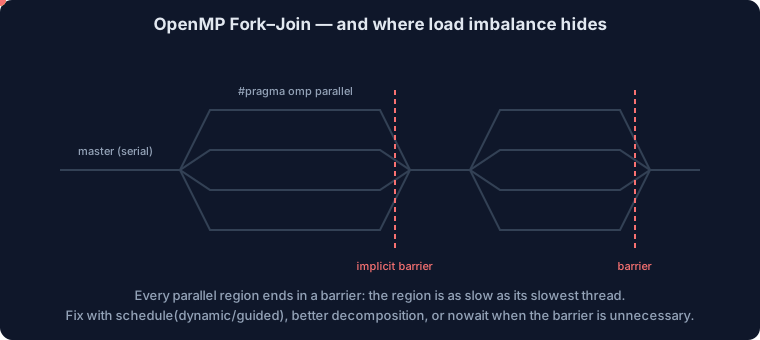
OpenMP = compiler directives + runtime library + env vars for shared-memory parallelism. Fork-join model: master thread forks a team at a parallel region, joins at the end.
#pragma omp parallel for reduction(+:sum) schedule(static)
for (i = 0; i < N; i++)
    sum += a[i] * b[i];
Compile with -fopenmp (GCC/Clang) or -qopenmp (Intel).
Core constructs
| Construct | Meaning |
|---|---|
#pragma omp parallel | fork a thread team; code runs on every thread |
#pragma omp for | split the following loop's iterations across the team |
#pragma omp parallel for | both at once (the workhorse) |
#pragma omp sections / section | different code blocks to different threads |
#pragma omp single | one thread executes (others wait at implicit barrier) |
#pragma omp master | master thread executes (no barrier) |
#pragma omp task | create an explicit task (irregular parallelism) |
#pragma omp simd | vectorize this loop |
#pragma omp target | offload to GPU (OpenMP 4.5+) |
Data-sharing clauses (where the bugs live)
| Clause | Meaning |
|---|---|
shared(x) | one copy, all threads see it (default for most variables) |
private(x) | each thread gets an uninitialized copy |
firstprivate(x) | private, initialized from the outer value |
lastprivate(x) | private, last iteration's value copied out |
reduction(op:x) | private copies combined with op (+, *, max, min, &&, …) at the end |
default(none) | force explicit clauses — best practice, catches races at compile time |
Loop index variables are automatically private. Everything else you write inside the loop: check it.
Scheduling
schedule(kind, chunk) controls iteration → thread mapping:
| Kind | Behavior | Use when |
|---|---|---|
static | contiguous chunks decided upfront (default) | uniform iteration cost; best locality, zero overhead |
static, c | round-robin chunks of c | cyclic imbalance patterns |
dynamic, c | threads grab chunks from a queue | irregular/unpredictable cost; overhead per chunk |
guided, c | dynamic with shrinking chunks | irregular, want fewer scheduling events |
auto / runtime | compiler / OMP_SCHEDULE decides | experimentation |
Synchronization
| Construct | Notes |
|---|---|
barrier | explicit team-wide wait (parallel/for/single already end with implicit barriers) |
nowait | remove the implicit barrier when safe — cheap speedup |
critical | one thread at a time (named criticals = separate locks) |
atomic | single memory update, hardware-supported, much cheaper than critical |
ordered | force loop-order execution of a block |
| locks | omp_set_lock etc. for data-structure-level control |
Cost intuition for accumulations: a tree/private reduction is usually fastest, then an atomic, then a contended critical region.
Tasks (OpenMP 3.0+)
For recursion, graphs, linked lists — things for can't split:
#pragma omp parallel
#pragma omp single
{
    #pragma omp task shared(x)
    x = fib(n-1);
    #pragma omp task shared(y)
    y = fib(n-2);
    #pragma omp taskwait
}
taskloop splits a loop into tasks; depend(in/out:...) builds task DAGs.
Task Parallelism and Runtimes
A task graph represents units of work as nodes and dependencies as edges. A task becomes runnable when all of its input dependencies are satisfied. OpenMP tasks, Cilk, Intel oneTBB, HPX, PaRSEC, StarPU, Legion, and Kokkos task facilities apply this model at different scopes.
Scheduling and granularity
- Work stealing gives each worker a local deque; idle workers steal from others. It balances irregular recursive work while preserving locality for the common case.
- Dynamic load balancing adapts when task costs are unknown or evolve, but scheduling and migration add overhead.
- Granularity must amortize task creation, queueing, dependency tracking, and cache misses. Coarsen tiny tasks; split long tasks that create a critical-path bottleneck.
- Asynchronous tasks/futures let useful work continue while a dependency, transfer, or I/O operation completes.
- Hierarchical scheduling maps coarse tasks across nodes/devices and fine tasks within a NUMA domain or accelerator.
The work-span bound explains the limit: T_p <= T_1/p + T_infinity. More workers cannot shorten the critical path. Profile task runtime distribution, ready-queue depth, steal rate, dependency stalls, and data movement—not merely worker utilization.
Data-aware task placement
Task runtimes can choose CPU/GPU implementations, move or replicate data, and schedule near the current data owner. This is powerful for heterogeneous nodes, but hidden transfers can dominate. Express access modes precisely, keep data resident across related tasks, and use priorities only when they shorten a real critical path.
Affinity and environment
| Variable | Purpose | ||
|---|---|---|---|
OMP_NUM_THREADS | team size | ||
| `OMP_PLACES=cores | sockets | threads` | where threads may run |
| `OMPPROCBIND=close | spread | master` | pin threads to places (close = pack, spread = distribute across sockets) |
OMP_SCHEDULE | schedule for runtime clauses | ||
OMP_STACKSIZE | per-thread stack (large private arrays!) |
OMP_PLACES=cores OMP_PROC_BIND=close is a sane default; spread when you want both sockets' memory bandwidth. See NUMA/first-touch in HPC-06-Computer-Architecture.md.
Classic OpenMP bugs
- race on a shared accumulator (missing
reduction) privateused wherefirstprivatewas needed (reads garbage)- false sharing on adjacent per-thread array slots
- nested parallelism accidentally enabled → oversubscription
- calling non-thread-safe library functions inside regions
- assuming iterations run in order (they don't unless
ordered)
Vectorization (SIMD in your code)
- Compilers auto-vectorize simple stride-1, dependence-free loops at
-O3(-march=nativeto use AVX-512). Check reports:-fopt-info-vec(GCC),-Rpass=loop-vectorize(Clang). - Blockers and fixes:
- Force it when you know it's safe:
#pragma omp simd(portable), withreduction/alignedclauses. - Alignment: allocate with
posix_memalign/aligned_allocto 64 B for clean AVX-512 loads.
- possible pointer aliasing → restrict qualifiers - loop-carried dependence → restructure or accept - function calls in loop → inline or use vector math libs (SVML, libmvec) - branches → convert to selects/masks where possible
MPI: Advanced Topics
Essentials (ranks, communicators, point-to-point, collectives, placement) are in HPC-02-Slurm-MPI.md. Course-level and production-level extras:
Point-to-point semantics
MPI_Sendmay buffer or block until matched — never assume either; assuming buffering causes the classic head-to-head deadlock (both ranks Send then Recv). Fixes: pair order by rank parity,MPI_Sendrecv, or non-blocking.- Modes: buffered
Bsend, synchronousSsend(completes only when receive starts — great for flushing out deadlocks in testing), readyRsend(rare). - Non-blocking:
MPI_Isend/MPI_Irecvreturn immediately; complete withMPI_Wait/Test/Waitall. Post receives early, overlap communication with computation betweenIsendandWait. - Persistent requests (
MPI_Send_init+MPI_Start): amortize setup for fixed communication patterns (halo exchange every iteration).
Collectives and their algorithms
| Collective | Semantics | Typical algorithm & cost (α–β model, n bytes, p ranks) |
|---|---|---|
Bcast | root → all | binomial tree: log p × (α + βn); pipelined for large n |
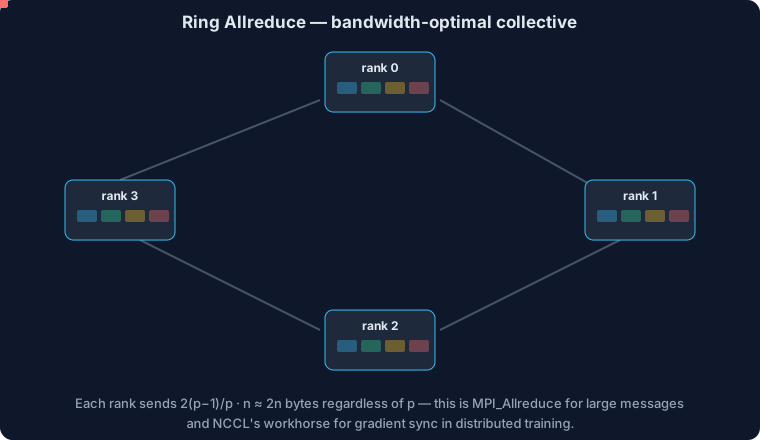
Reduce/Allreduce | combine values (+, max…) | recursive doubling (small), reduce-scatter + allgather / ring (large): 2(p−1)/p × βn — bandwidth-optimal; this is "ring allreduce" from ML |
Scatter/Gather | distribute/collect blocks | tree |
Allgather | everyone gets everything | ring or recursive doubling |
Alltoall | personalized exchange | the most network-hungry; needs bisection bandwidth (FFT transpose, sorting) |
Barrier | synchronize | dissemination, O(log p) |
Non-blocking collectives (MPI_Iallreduce, …) overlap collectives with compute. At scale, collectives dominate — know that allreduce cost is ~2βn regardless of p (good) but alltoall stresses bisection (bad on oversubscribed fabrics).
Derived datatypes
Describe non-contiguous data (a matrix column, a strided face of a 3D block) so MPI sends it without manual packing: MPI_Type_vector, MPI_Type_create_subarray, MPI_Type_create_struct, then MPI_Type_commit. Cleaner and often faster than MPI_Pack.
Communicators, groups, topologies
MPI_Comm_split(comm, color, key, &newcomm): partition ranks (e.g., row/column communicators for 2D algorithms like SUMMA).- Cartesian topology:
MPI_Cart_createmaps ranks onto a grid with optional periodicity;MPI_Cart_shiftyields halo-exchange neighbors; lets MPI reorder ranks to match the physical network.
One-sided communication (RMA)
Expose a memory window (MPI_Win_create); others MPI_Put/Get/Accumulate without the target calling receive. Synchronize with fence or lock/unlock epochs. Useful for irregular access; PGAS-like within MPI.
Threads + MPI
MPI_Init_thread levels: SINGLE, FUNNELED (only master thread calls MPI — the common hybrid choice), SERIALIZED, MULTIPLE (any thread; more runtime overhead).
MPI-IO (parallel I/O)
All ranks open one file (MPI_File_open); file views (with subarray datatypes) map each rank onto its region; collective I/O (MPI_File_write_all) lets the library aggregate small strided writes into large sequential ones (two-phase I/O). HDF5 parallel and NetCDF sit on top of this — prefer them for real applications: self-describing files + tuned MPI-IO underneath. One shared file with collective I/O beats file-per-rank at scale (metadata storms — see HPC-03-Storage-Networking-Operations.md).
GPU Programming (CUDA)
Architecture background in HPC-06-Computer-Architecture.md.
Thread hierarchy
- Grid → blocks → threads. You launch
kernel<<<blocks, threadsPerBlock>>>(...). - Block size: multiple of 32 (warp size), commonly 128–256.
- Each thread computes its global index:
__global__ void saxpy(int n, float a, float *x, float *y) {
    int i = blockIdx.x * blockDim.x + threadIdx.x;
    if (i < n) y[i] = a * x[i] + y[i];
}
/* host: */
saxpy<<<(n + 255)/256, 256>>>(n, a, d_x, d_y);- Threads in a block can cooperate via shared memory and
__syncthreads(); blocks are independent (that's what lets the GPU scale).
Memory model and the rules that matter
| Memory | Scope | Notes |
|---|---|---|
| Registers | thread | fastest; spills hurt |
| Shared memory | block | user-managed cache, ~100 KB/SM; watch bank conflicts |
| Global (HBM) | grid | 1–3 TB/s only if coalesced |
| Constant | grid | broadcast-friendly read-only |
| Host memory | — | PCIe/NVLink transfers; minimize! |
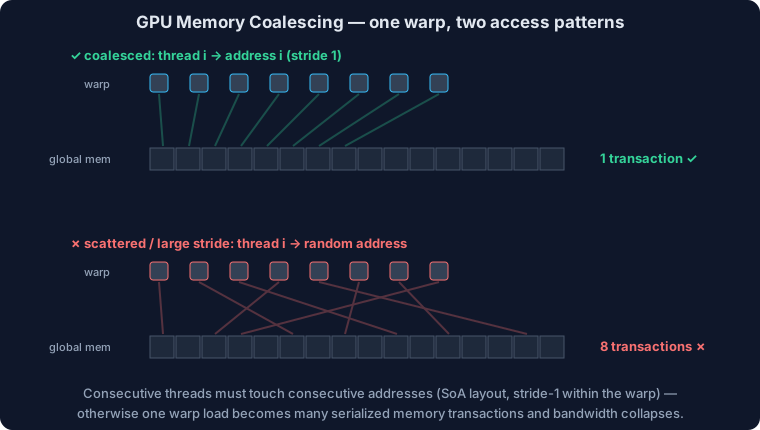
- Coalescing: consecutive threads must access consecutive addresses so a warp's 32 loads merge into few transactions. SoA layouts, stride-1 within warps.
- Divergence:
ifbranches taken differently within one warp serialize both paths. - Occupancy: enough resident warps per SM to hide memory latency — limited by registers/thread, shared mem/block, block size.
- Tiling in shared memory: the GPU matmul pattern — each block loads tiles of A and B into shared memory, syncs, multiplies, moves on.
Host-device flow and overlap
cudaMalloc → cudaMemcpy(H2D) → kernel<<<>>> → cudaMemcpy(D2H) → cudaFree- Kernel launches are async; use streams + pinned host memory (
cudaMallocHost) to overlap copy and compute (pipeline chunks). - Unified memory (
cudaMallocManaged): pages migrate on demand — convenient, profile before trusting for performance. - Profile with Nsight Systems (timeline) / Nsight Compute (kernels).
Multi-GPU and communication
- NCCL: topology-aware collectives (allreduce, etc.) over NVLink/IB — the backbone of multi-GPU training.
- GPU-aware MPI / GPUDirect RDMA: pass device pointers straight to MPI; NIC reads GPU memory without a host bounce.
- Bind each rank to the GPU (and NIC) on its NUMA node.
Portability layers
- OpenACC (
#pragma acc parallel loop) and OpenMP target offload: directive-based GPU offload for legacy Fortran/C. - HIP: AMD's CUDA-alike (source-portable), SYCL/oneAPI: C++ single-source for Intel/others, Kokkos/RAJA: C++ performance-portability libraries used by big DOE codes.
Hybrid Programming
MPI + OpenMP
Why: fewer ranks → less halo memory and fewer messages, larger messages, and threads share cache. Standard recipe:
- 1 rank per socket (or per NUMA domain),
OMP_NUM_THREADS= cores in that domain MPI_Init_thread(FUNNELED), communicate outside parallel regions (or from master)- Slurm:
--ntasks-per-node=2 --cpus-per-task=32,OMP_PLACES=cores OMP_PROC_BIND=close
MPI + CUDA
1 rank per GPU is the standard layout; overlap halo exchange with interior computation using streams + non-blocking MPI.
PGAS Languages (one-liners you should recognize)
- UPC: C with a partitioned shared array space.
- Coarray Fortran:
a[i]on other images, part of the Fortran standard. - Chapel: Cray's high-level parallel language (locales, domains).
- Idea: global address space with explicit locality — nicer for irregular access; adoption remains niche vs MPI.
Choosing a Model (exam-style decision)
- Single node, loop-parallel → OpenMP.
- Multi-node → MPI (+ OpenMP per node when rank counts or halo memory hurt).
- Massive regular data parallelism, high arithmetic intensity → GPU.
- Independent tasks → no MPI at all; job arrays (HPC-02-Slurm-MPI.md).
- Irregular fine-grained remote access → one-sided MPI / PGAS.
Interview / Exam Summary
- Fork-join, data-sharing clauses,
reduction, schedules (static vs dynamic vs guided) — and the bugs: races, false sharing, wrong privatization. default(none)andnowaitare the marks of someone who has actually written OpenMP.- MPI: why Send/Recv deadlocks happen, non-blocking overlap, Sendrecv, derived datatypes, comm split, Cartesian halo exchange, allreduce = reduce-scatter + allgather.
- CUDA: grid/block/thread, coalescing, shared-memory tiling, divergence, occupancy, streams overlap, NCCL.
- Hybrid: 1 rank per NUMA domain / per GPU; FUNNELED; bind everything.